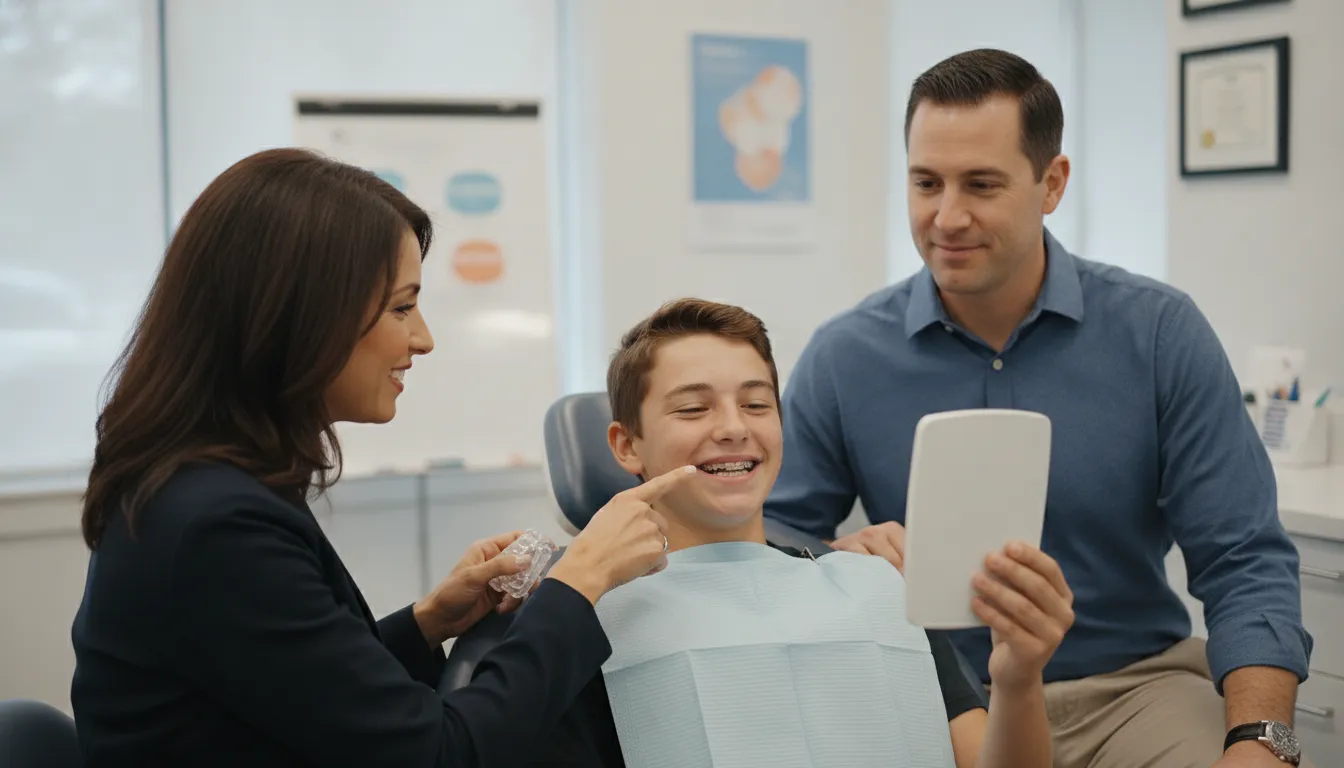
Early orthodontic questions often arise while a child still has baby teeth. Crowding, spacing, a developing bite, or habits such as thumb sucking can make parents wonder whether to watch and wait or schedule an evaluation.
For families exploring an Invisalign First for children orthodontist, Invisalign First is a clear aligner program designed for growing smiles and often used as part of Phase I treatment. Its goals may include guiding developing arches, maintaining space, and making room for incoming permanent teeth. An orthodontic evaluation determines whether it fits a child’s needs and timing.
The American Association of Orthodontists recommends a first check-up by age 7, when children commonly have a mix of baby and permanent teeth. In Athens, Grayson, Watkinsville, and nearby Northeast Georgia, Russell Orthodontics helps families understand what is developing now. What can wait, and what treatment options may support the next stage. That starts with understanding what Invisalign First is designed to do.
What Is Invisalign First for Children?
Invisalign First is a clear aligner system created for children whose teeth, jaws, and dental arches are still developing. Unlike an adult-focused alignment plan, it is designed around a changing smile. The aligners are custom-made and removable, allowing a child to take them out for meals, brushing, and flossing while guided tooth movement is planned by an orthodontist. Invisalign describes the program as designed for growing smiles and commonly references children ages 6 to 10, although age alone does not determine whether treatment is appropriate. Invisalign First for children may be considered when an evaluation shows that early guidance could support the developing bite.
A Phase 1 approach for a developing smile
Invisalign First is one way an orthodontist may provide Phase 1 treatment, also called early or interceptive treatment. The focus is not simply on straightening the teeth that are visible today. Phase 1 planning considers the relationship between the teeth, arches, and growing jaws, as well as the permanent teeth still to come.
Depending on a child’s needs, the goals may include making room for incoming permanent teeth. Supporting space maintenance, guiding growth, or addressing concerns such as crowding, spacing, or narrow dental arches. Some children may also have bite concerns, including an overbite, underbite, or crossbite. These are treatment considerations, not a diagnosis that can be made from a photograph or online article.
What makes Invisalign First different?
Young smiles change as baby teeth are lost and permanent teeth erupt. Invisalign First aligners are designed for this stage of development and can accommodate changing dentition. Their smooth, clear design has no brackets or wires, and their removable format can make it easier for families to maintain normal eating and oral hygiene routines. A child still needs to wear the aligners as directed and participate in regular clinical oversight. Removability is helpful, but it also makes family support and daily consistency important.
Education before diagnosis
Learning about Invisalign First can help parents understand the vocabulary and questions to bring to an appointment. It cannot determine whether a child needs Phase 1 treatment, whether Invisalign First is the right appliance, or whether observation is the better choice. Not every child needs early treatment, and early treatment does not guarantee that later orthodontic care will be unnecessary.
An orthodontic evaluation gives the clinician an opportunity to assess the developing teeth and jaws, discuss timing, and explain the goals of any recommended plan. Families exploring early orthodontic treatment can use that conversation to understand what is happening now, what should be monitored, and how the plan fits their child’s school, activities, and everyday routine.
When Should a Child See an Invisalign First for Children Orthodontist?
There is no universal birthday that determines when treatment should begin. The right timing depends on how a child’s teeth are erupting, how the jaws are developing, the bite relationship, and the goals of early care. An evaluation gives parents a clearer answer than waiting for every permanent tooth to appear.
Why age seven is a useful checkpoint
The American Association of Orthodontists recommends that children complete an initial orthodontic check-up by age 7. At this stage, many children have a mix of baby and permanent teeth. That allows an orthodontist to observe how the developing smile is taking shape. The visit does not mean treatment must start. It can establish a baseline, identify a developing concern, and clarify whether monitoring or treatment is appropriate. Learn more about a child’s first orthodontic check-up.
Children younger than 7 do not necessarily need to wait if a parent notices something unusual. A timely assessment may be helpful when teeth are erupting in an unexpected position. It can also help when baby teeth are lost unusually early or late, or when the bite does not appear to fit comfortably. Painful chewing, persistent mouth breathing, or difficulty bringing the teeth together are also reasonable reasons to ask questions. These signs do not diagnose a problem, but they deserve professional attention.
Signs that may merit an orthodontic assessment
- Noticeable crowding or spacing as permanent teeth begin to appear.
- A crossbite, overbite, underbite, or bite that shifts to one side.
- Teeth that seem blocked, delayed, or out of their expected path.
- Early or late loss of baby teeth.
- Persistent thumb sucking, pacifier use, or another oral habit affecting development.
- Pain or difficulty when chewing, or frequent mouth breathing.
Oral habits can influence a developing smile, so parents may also find it useful to review these developing teeth and habits with their child’s dentist and orthodontist.
Does an evaluation automatically mean Invisalign First?
No. Invisalign First is not the right fit for every child or every early orthodontic concern. An orthodontist may recommend observation, a focused Phase 1 approach, Invisalign First, another appliance, or no immediate treatment. The decision considers growth, eruption, bite development, and whether a child can participate in the recommended plan.
For families exploring an Invisalign First for children orthodontist, the most useful next step is an individualized evaluation. Choosing treatment based on age alone can miss important details about a child’s development.
What Can Phase 1 Treatment Do?
Phase 1 treatment focuses on the conditions that shape a child’s developing smile. The goal is not to rush every child into orthodontic treatment. It is to identify concerns early and decide whether guiding growth, tooth position, or the available space could support healthier development.
Creating room for developing teeth
As baby teeth make way for permanent teeth, a child may not have enough room for everything that needs to erupt. Phase 1 care may address crowding or spacing and help maintain space when baby teeth are lost earlier than expected. Invisalign First is designed for growing smiles, including children whose teeth and jaws are still developing. The system can accommodate changing dentition as baby teeth fall out and new teeth come in. Invisalign First for children is one approach an orthodontist may consider when removable aligner treatment fits the child’s needs.
Supporting arch width and bite development
Some children have a narrow dental arch or a bite that is developing unevenly. Depending on the examination, Phase 1 goals may include palatal expansion, space development, or guidance for the relationship between the upper and lower teeth. Parents may hear terms such as crossbite, overbite, or underbite during an evaluation. These descriptions help the orthodontist understand how the teeth and jaws fit together, but they do not determine treatment on their own.
For families researching options, an Invisalign palate expander may be relevant to a discussion about expanding the dental arch. The right appliance or sequence depends on the child’s growth, eruption pattern, bite, and ability to follow care instructions.
Guiding growth with realistic goals
Growth guidance and space maintenance are intended to address a specific developing concern, not to promise a finished smile on a fixed schedule. Early treatment is generally more focused than comprehensive treatment for adolescents or adults. It may make a later stage more manageable for some children. But Phase 1 does not guarantee that a child will avoid Phase 2 or need no further orthodontic care. Research also shows that the strength of evidence varies by condition, so an orthodontist should explain which goal applies to your child and why.
A consultation is the best way to separate a normal variation from a concern worth monitoring. Russell Orthodontics evaluates each child individually before recommending early orthodontic treatment, with goals that reflect the child’s development and the family’s priorities.
Invisalign First vs Traditional Braces for Young Children
For a young child, the best appliance depends on the developing smile, the treatment goals, and the child’s ability to participate in daily care. Invisalign First is designed for growing smiles and can be used as part of Phase I treatment. Traditional braces remain a well-established approach that may be appropriate when fixed control is the better fit. Neither choice is right for every child, so the decision should follow an orthodontic evaluation rather than a comparison made from appearance alone.
How the day-to-day experience differs
| Consideration | Invisalign First | Traditional braces |
|---|---|---|
| Visibility | Clear aligners are generally less noticeable during school, activities, and social time. | Brackets and wires are visible, although children may enjoy choosing colored ties. |
| Eating and cleaning | Aligners are removable for meals, brushing, and flossing. They must be cleaned and put back in as directed. | Food is eaten around the appliance, so brushing carefully around brackets and wires becomes part of the routine. |
| Daily responsibility | The child and parent must keep track of the aligners and follow the prescribed wear routine. | The appliance stays in place, but the child must protect it and follow instructions about foods and hygiene. |
| Clinical oversight | Progress is reviewed through scheduled visits and, when included in the plan, digital monitoring. | Progress is reviewed at scheduled visits while the orthodontist adjusts the fixed appliance as treatment develops. |
| Case fit | May suit selected developing cases involving concerns such as crowding, spacing, or arch development. | May suit cases where a fixed appliance provides the control or consistency the treatment plan requires. |
What matters beyond appearance
Removability can make meals and oral hygiene simpler, but it also creates a responsibility that a young child cannot manage alone. Parents may need to help with storage, cleaning, and remembering to replace the aligner after eating. With braces, the appliance does not depend on remembering to put it back in, but brushing and food choices require consistent attention.
Clinical fit matters just as much. Invisalign First is a clear aligner system designed for children whose teeth and jaws are still developing, including changing dentition. Phase I planning may address goals such as space maintenance, palatal expansion, or growth guidance. Traditional braces may be considered when fixed mechanics offer a more suitable path for the specific movement or oversight needed. An evaluation determines which approach is appropriate.
A practical choice for your family
At Russell Orthodontics, the conversation can include your child’s habits, maturity, school routine, activities, and developing bite. A digital plan can help the family understand the proposed goals without promising a universal result or eliminating the possibility of later treatment. Learn more about Invisalign First for children and how it may fit into a broader early treatment plan. The right choice is the one that matches the clinical need and gives your child the support needed to follow through.
How Does Invisalign Teen Fit the Next Stage?
As a child grows into the teen years, orthodontic care becomes part of a more independent routine. School schedules, sports, performances, meals with friends, and changing priorities all shape the conversation. Invisalign Teen is designed for adolescent treatment, while Invisalign First is intended for younger children whose teeth and jaws are still developing. The right choice is not determined by age alone. An orthodontic evaluation helps clarify what is developing, what needs guidance, and how much responsibility a teen can comfortably manage.
From a developing smile to adolescent treatment
Invisalign First is commonly discussed for children in the early-treatment years. An orthodontist may monitor or address spacing, erupting teeth, arch development, or growth. Invisalign Teen focuses on the next stage of care, when more permanent teeth are present and treatment may involve aligning the teeth and coordinating the bite. Some children move from an early Phase I plan into later treatment, while others are monitored until the timing is appropriate. Phase I does not guarantee that later orthodontic care will be unnecessary. Families benefit from a plan that explains both the immediate goals and possible next steps.
Russell Orthodontics identifies children ages 7 to 12 and teens ages 13 to 17 as core patient groups. That age range is a guide, not a diagnosis. Growth, tooth eruption, bite development, oral habits, and individual readiness all matter. Parents can learn more about the teen-focused approach on the Invisalign for teens page.
What makes Invisalign Teen practical for families?
Teenagers often want treatment that fits their appearance and activities. Removable aligners can be taken out for meals and routine oral hygiene, while the treatment plan still depends on consistent use and responsible care. Invisalign Teen also includes compliance indicators, which can help parents and the orthodontic team discuss aligner use with clearer information rather than relying only on guesswork. Replacement aligners for lost trays address a realistic part of adolescent life, especially when a teen is moving between school, practice, travel, and home.
Parents can support success without turning every day into a conflict:
- Keep the aligner case in the same place at home and pack a backup case for activities.
- Build aligner care into existing routines, such as brushing before school and bedtime.
- Ask open questions about comfort, fit, and school or sports concerns.
- Contact the orthodontic team promptly if an aligner is lost, damaged, or no longer fitting as expected.
Balancing oversight with growing independence
Adolescents deserve an active role in treatment decisions, but parents still provide the structure that makes routines easier. Russell Remote uses DentalMonitoring with weekly scans through the ScanBox Pro device and smartphone app. Depending on the treatment plan, routine in-office visits may occur every 12 to 16 weeks rather than monthly. That combination can support family convenience while keeping professional oversight connected to the plan. A consultation can help your family compare the needs of a younger child and a teen, so each smile receives age-appropriate care with confidence, convenience, and choice.
What Families Can Expect From Russell Orthodontics
Choosing care for a developing smile should feel informative, not overwhelming. At Russell Orthodontics, a family visit is designed to give parents and children a clear understanding of what is happening. What options may fit, and how care can work within everyday life. The process combines orthodontic expertise with digital planning and communication that respects school, activities, and family schedules.
A thoughtful evaluation and digital starting point
A first visit begins with conversation and evaluation. The orthodontic team considers your child’s developing teeth, bite, growth, and overall needs rather than assuming that every child should start treatment at the same age. Families can use a free orthodontic consultation to discuss concerns such as crowding, spacing, erupting teeth, or a bite that does not seem to fit comfortably.
When appropriate, an iTero digital scan provides a detailed view without the discomfort of traditional impression material. The digital iTero scan can support diagnosis, treatment planning, and parent education. Children can see and better understand the process, while parents receive an explanation of the goals and timing being considered.
Seeing the plan before treatment begins
Digital records also support ClinCheck treatment visualization. This helps the team explain how planned tooth movements may progress and gives families a visual way to discuss the proposed approach. Visualization is an educational tool, not a promise of a guaranteed result. The orthodontic evaluation remains the foundation for deciding whether Invisalign First, another approach, observation, or a later stage of care is appropriate.
For younger children, that conversation may focus on the needs of a growing smile and the goals of Phase I treatment. For teens, it may include how Invisalign Teen fits school, sports, meals, and daily routines. Because Russell Orthodontics treats children, teens, and adults, families may also coordinate care for multiple members of the household in one practice.
Ongoing support with Russell Remote
Care does not stop when the aligners are delivered. Russell Remote virtual monitoring uses DentalMonitoring, weekly scans, the ScanBox Pro device, and a smartphone app to help the team follow progress between visits. The family still receives professional oversight, while routine in-office appointments may occur every 12 to 16 weeks rather than monthly, depending on the treatment plan.
Russell Orthodontics has locations in Athens, Grayson, and Watkinsville, serving families throughout Northeast Georgia. With more than 20 years of Invisalign experience and a current Top 1% Blue Diamond Invisalign Provider standing. The practice brings specialized experience to a family-centered model built around Confidence, Convenience, Choice.
Frequently Asked Questions
What is the best age to start Invisalign First?
There is no single start age for every child. Invisalign First is designed for developing smiles, often between ages 6 and 10, while the right timing depends on tooth eruption, jaw development, and the treatment goal. The American Association of Orthodontists recommends an initial orthodontic check-up by age 7, but a child with a noticeable concern can be evaluated sooner. Learn more from the AAO.
How do I know if my child is a good candidate?
An orthodontic evaluation is the only reliable way to determine candidacy. The orthodontist will consider crowding, spacing, bite development, arch shape, erupting teeth, oral habits, and whether your child can follow the aligner plan. Invisalign First can be a thoughtful option for many children, but it is not the right fit for every early case.
Can Invisalign First replace Phase 2 treatment?
Phase 1 treatment can guide development, create space, or address a specific early concern, but it does not guarantee that a child will avoid later treatment. After evaluating growth and permanent tooth eruption, your orthodontist can explain whether observation, Phase 1 alone, or a later Phase 2 plan makes sense.
Should a 12-year-old get Invisalign First or Invisalign Teen?
Age alone does not decide the answer. The choice depends on which teeth have erupted, the bite and growth pattern, treatment goals, and your child’s ability to wear and care for aligners. A personalized evaluation helps determine whether Invisalign First, Invisalign Teen, braces, or monitoring best supports the next stage.
What should we do before starting aligner treatment?
Schedule an orthodontic evaluation and bring questions about school, sports, meals, hygiene, and appointment timing. The visit may include a digital scan and a discussion of your child’s developing smile. Your orthodontist can then outline the recommended sequence, family responsibilities, and practical next steps without asking you to make a decision before the findings are clear.
Book a Free Orthodontic Consultation
Every child’s smile develops on its own timeline. A consultation gives your family a chance to discuss your child’s or teen’s needs, ask questions, and understand which next step may fit best. Book a free orthodontic consultation with Russell Orthodontics to start the conversation. You can bring your questions about Invisalign First, Phase 1, or Invisalign Teen, and leave with clearer guidance for your family.